Betting odds explained: how do they work, why do they change
Published on 13 Jul 2021 | Last updated on 01 Jul 2026 | Reading time: 7 minutes
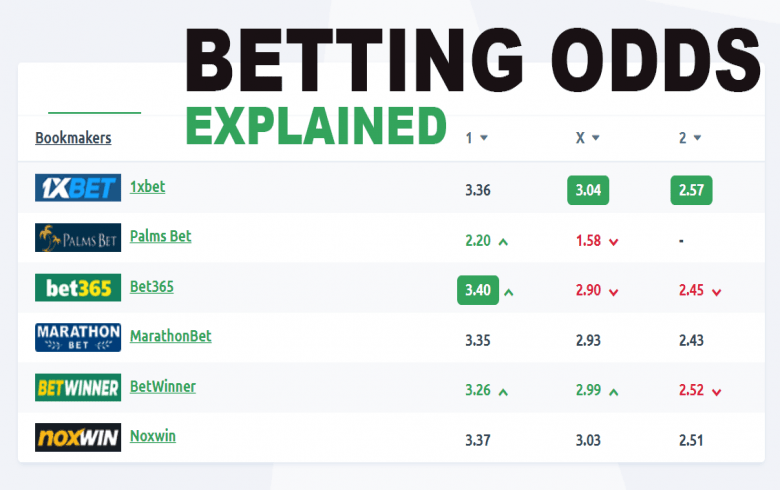
People bet on anything and everything. Whether you are watching football games, horse races, or putting bitcoins into a casino, statistics show that people tend to love the thrill of hope and the risk of loss. But there's one thing that separates all these endeavors: betting odds. Betting odds are the thing that differentiates the pro from the one that just got really lucky this one time. It is really unsurprising that the words ‘betting odds explained’ have been commonly searched by the majority of people who want to get the basics of how things are done in the betting world. Therefore, to spare you some time, in today's article we are going to take a deep look at betting odds’ nature and development, how they affect us and why it is important to know them.
Hang in there and don’t stop reading because things are just about to get interesting.
What are betting odds?
Without further ado, let’s get on with our discussion. Betting odds are numbers that are used to indicate the probability of winning or losing a bet. They are usually compiled by different bookmakers, meaning that there can be several outcomes for any given event. The basic principle here is as follows: the higher the odds for your wager, the more you need to risk in order to generate a reward that is close enough to your desired return. This would mean that one must be very aware of what they are doing so that they would not lose their money.
There are different kinds of odds. However, the most popular and frequently used are decimal, fractional, and moneyline odds. Later on in our article, each of these three types will be thoroughly discussed. The most important thing to remember here is that each type is calculated differently, but shares the same purpose – to give an idea of a potential return to an interested party. The odds also show a gambler how much he or she needs to risk in order to win a certain reward.
Betting odds are applied in a wide range of betting activities, such as sports, horse racing, casino gaming, and more. Besides soccer and other sports, such as golf or hockey, there are also betting odds applying to some types of financial markets. While betting odds in financial markets is an interesting topic itself, today we are focusing mostly on explaining how soccer betting odds work.
What is probability?
Betting odds are inseparably connected to probability. So what does probability mean exactly and how does it relate to odds? Let's start by saying that probability is a mathematical term, used in a variety of contexts, including gambling. The most common definition says that it is a means to measure the likelihood of an event taking place. It can also be described as the likelihood of an event happening, compared to its occurrence in the past.
When it comes to soccer bettings, probability theories are used for two main reasons:
- Firstly, it takes into account all possible outcomes of interactions between elements of events or conditions that are subject to statistical analysis. This means that before we start betting on something, we make sure that all possible combinations, regarding this thing, have occurred before in our experience.
- Secondly, probability theory allows us to formulate the expectations of the outcome, which is very useful to estimate the outcome of a wager or play.
How to use betting odds to calculate probability
When it comes to using betting odds to calculate probability, we must pinpoint two important terms - favorites and underdogs. 'Favorites' may be kind of self-explanatory, but nevertheless, we will tell you that this is the team or the player that is considered more likely to win the game. That makes the underdogs the teams or the players, that have a lower chance of winning the game, the race, or the competition. To make it easier for you to understand, we will give you the following example:
- Team A has a 1.2 betting odds
- Team B has 3.5 betting odds
Which team is more likely to win the game? Well, if you said Team A, then congratulations, you are correct. Team A is the favorite, while Team B is the underdog. But why so? The explanation is quite easy, so bear with us. Lower betting odds mean a higher chance of winning. It may be a bit counterintuitive at first but after you give it a bit of thought you will come to the realization that lower betting odds mean a lower risk of losing, therefore you will get a lower reward. The higher the betting odds, the higher the risk of losing. So if by any chance, Team B wins the game, the reward you will get, if you had placed your money on it beforehand, would be higher than the reward you would get, if Team A had won the game.
How do betting odds work?
"How do betting odds work?” one may ask. Let us explain. First and foremost you must start with data analysis. You will create a log of all previous results and that's where you have to pay attention to time. Is it a time when the outcome of an event is known? If it is, then use it for your analysis. It's important here because if you would use data before the outcome was known, you would have a great disadvantage over bettors that use live odds. Any event that may happen must be taken into account.
Disclaimer: Before we get into the details about how the different betting types work, we must inform you that for the sake of all examples you will read until the end of the article, the USD currency will be used.
Decimal betting odds explained
The first type of betting is decimal. That is mainly the European way of betting, but it is also commonly used in New Zealand, Australia, and Canada. What is really important here is that the underdogs and the favorites can be spotted just by looking at the numbers.
The calculation process here is alleviated as the decimal odds number accurately represents the amount of money one wins for every 1$ wagered. This means that the number actually represents the total payout, not just the profit itself. Now let’s give you an example: you have two separate teams - Team A and Team B. The decimal odd number for Team A is 1.5, while the odds for Team B are 3.5. We are reminding you that this is the amount you could win for every $1 put at stake. If you bet $100 on Team B and the team wins, that would make your total payout $350. The amount includes not only the initial stake of $100 but also the profit of $250.
Fractional betting odds explained
Fractional odds are mainly used by the British and Irish bookmakers. When it comes to how odds are written, we can say that a slash(/) or a hyphen (-) are used depending on the bookmakers. An example would be 4-1 or 4/1. But what do these numbers mean? In our given example of a fractional listing of four-to-one odds, it would mean that you would get $4 against every $1 you bet. And that is in addition to receiving your invested dollar back, leaving you with $5 in total.
While this type of odds provides a more precise representation of the payouts, the calculation process here is more complicated than with decimal odds. Why is that really? Well, you must find out how much money you win for every $1 wagered. Do not forget that the odds represent only your payout and they don't really include the initial amount that you wagered.
Moneyline betting odds explained
Used mostly in the United States of America, this type of betting odds works by betting on the final result of an event in a given amount of time. In this case, you may bet on a particular team to win or, for example, on the favorite and underdog to get the majority vote. For favorites, the odds are written with a minus (-), and the odds for underdogs are accompanied by a positive sign (+).
For favorites, the odds with a - indicate the amount you need to stake in order to win $100. And for underdogs, the + sign indicated the amount of money won for every $100. The main thing here is just to remember that these odds don't include your initial bet amount and wagering on favorites would mean you win less than what appears in your payout. On the other hand, when betting on underdogs your payout is bigger than it seems and that's why this type of betting is widely popular among sports enthusiasts.
Why do betting odds change?
One of the most common questions every bettor asks at one point or another, is ‘‘Why do betting odds change?’’ Now let’s look into it. Firstly, to answer the question, it is necessary to understand what the outcome of an event may be. Depending on the outcome, the odds change.
Betting odds changes occur due to many factors – team selections, injuries, or even events outside anyone’s control can influence the outcome of the event. Therefore, potential changes must be always taken into account.
Why trust Soccerbets365 for your soccer predictions?
For over 20 years, Soccerbets365 has been on the betting market, predicting the outcomes of various soccer, tennis, hockey, volleyball, and basketball games. We provide you free daily predictions, which you can follow when placing your bets. In order to give you the most accurate predictions, we analyze the statistics and the current trends thoroughly.
Summary:
Now that you've had everything about betting odds explained thoroughly, you are ready to take over the world. You know not only how the betting system works, but you are also aware of the different betting types and what exactly probability means. We were more than happy to give you this information. For more information on this and similar topics, you can visit our blog.