The Numbers Don't Lie: Mind-Blowing Facts, Patterns, and Curses Heading Into the 2026 FIFA World Cup
Published on 07 Jun 2026 | Last updated on 10 Jun 2026 | Reading time: 9 minutes
A Tournament Unlike Any Other
Every four years, the world stops to watch 22 men chase a ball. But the 2026 FIFA World Cup, hosted across the United States, Canada, and Mexico, isn't just another edition of the game's greatest spectacle — it's a structural reinvention of football's most sacred competition.
For the first time, 48 nations will compete across 16 host cities in three countries, playing 104 matches over 39 days. That's a jump from the 64 matches played in Qatar 2022 — a 62% increase, compressed into roughly the same tournament window. Think of it as a Premier League season condensed into five relentless weeks.
The Scale Is Genuinely Unprecedented
Four nations are making their World Cup debut for the very first time: Cabo Verde, Curaçao, Jordan, and Uzbekistan. Curaçao — a Caribbean island of fewer than 160,000 people — will become one of the smallest nations ever to compete on football's biggest stage.
The age spread across squads captures the full arc of a career in one tournament. Mexico's Gilberto Mora arrives at just 17 years and 240 days. Scotland's goalkeeper Craig Gordon is 43 years and 162 days old. Twenty-two players under 20 will compete. Seven players are aged 40 or above.
Lionel Messi, Cristiano Ronaldo, and Mexico's Guillermo Ochoa will each make their sixth World Cup appearance — a record that has never been achieved in the tournament's 96-year history. There's a twist in the scheduling: Mexico's opener is June 11, while Argentina kick off June 16 and Portugal kicks off June 17. If Ochoa takes the field against South Africa, he officially becomes the first player in history to appear in six different World Cups — days before Messi and Ronaldo reach the same milestone.
Three Countries, Three Climates, One Headache
Matches will be played from Boston on the US East Coast to Vancouver on Canada's Pacific shore, and deep into central Mexico — a span of more than 4,000 kilometres. To manage this logistical challenge, FIFA introduced a Regional Cluster System, grouping the 16 host cities into three geographic pods so teams don't fly across the continent between group games.
Mexico City's altitude of 2,200 metres introduces a fascinating wildcard. Lower oxygen levels affect stamina, pressing intensity, and sprinting ability. Teams unfamiliar with altitude will be at a measurable physiological disadvantage — something coaches have been modelling for years.
The Curse of the Champion
No pattern in football history is as statistically robust — or as brutally unforgiving — as the Defending Champion Curse. Since 2002, three of the six World Cup champions have been eliminated in the group stage of the following tournament. Not knocked out in the quarter-finals. Sent home before the knockout phase even begins.
| Champion | Title | Next Tournament | Result |
|---|---|---|---|
| France | 1998 | 2002 | Group stage exit |
| Brazil | 2002 | 2006 | Quarter-finals |
| Italy | 2006 | 2010 | Group stage exit |
| Spain | 2010 | 2014 | Group stage exit |
| Germany | 2014 | 2018 | Group stage exit |
| France | 2018 | 2022 | Runners-up |
| Argentina | 2022 | 2026 | ? |
The only back-to-back winners in World Cup history are Italy (1934 and 1938) and Brazil (1958 and 1962). No team has repeated since — that's 64 years without a successful title defence. Now Argentina — winners in Qatar 2022 — stand in exactly that spot, trying to defy history.
The FIFA Rankings Curse: A Stranger Pattern Still
Here is a fact that sounds like football mythology — but is entirely true. Since FIFA introduced its world rankings in December 1992, no team that entered a World Cup as the number one-ranked nation has gone on to win the tournament. Not once, across eight tournaments.
- ►1994: Germany ranked #1 — Brazil won (ranked #2)
- ►1998: Brazil ranked #1 — France won (on home soil, ranked #18)
- ►2002: France ranked #1 — Brazil won (ranked #2)
- ►2006: Brazil ranked #1 — Italy won (ranked #13)
- ►2010: Brazil ranked #1 — Spain won (ranked #2)
- ►2014: Spain ranked #1 — Germany won (ranked #2)
- ►2018: Germany ranked #1 — France won (ranked #7)
- ►2022: Brazil ranked #1 — Argentina won (ranked #3)
The number one ranking, far from being a golden ticket, appears to carry its own statistical curse. The pressure of favouritism, hyper-specific preparation by opponents, and the sheer randomness of a knockout tournament all conspire against the team carrying the heaviest expectations.
The Foreign Coach Curse: 96 Years, Zero Exceptions
Across all 22 World Cups ever played, every single winning manager shared a nationality with the country he coached — without one exception, from Uruguay 1930 all the way to Argentina 2022. Foreign coaches have been present at every modern tournament in large numbers — 27 of the 48 nations at 2026 are led by managers of a different nationality, including high-profile appointments like Thomas Tuchel with England and Carlo Ancelotti with Brazil. Ancelotti himself acknowledged the pattern, saying, "No foreign-born coach has ever won the World Cup — but there is always a first time." In 2026, with over half the field managed by outsiders, that first time has never felt closer. But 96 years of unbroken history suggest the sport's most stubborn unwritten rule won't surrender without a fight.
Home Advantage: Real, Powerful, and Complicated
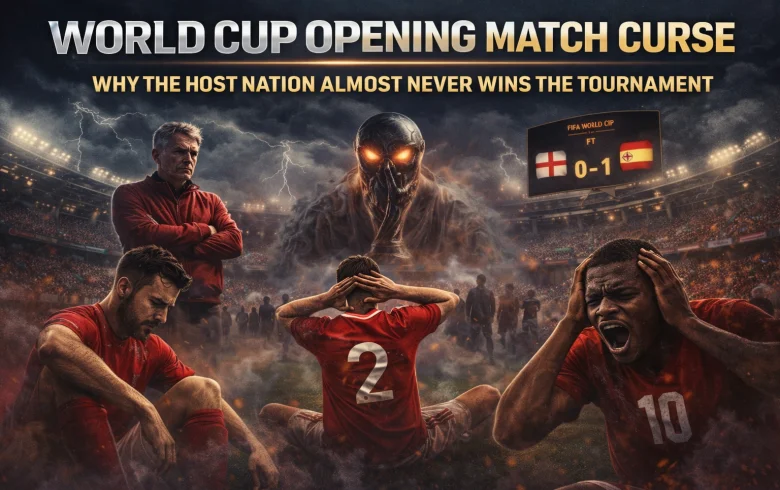
Six of the 22 World Cups played before 2026 were won by the host nation — Uruguay (1930), Italy (1934), England (1966), West Germany (1974), Argentina (1978), and France (1998). That's a 27% win rate, far above what random chance would predict. Beyond outright wins, host nations have reached the semi-finals in roughly half of all World Cups ever staged.
But history offers an important caveat. South Africa in 2010 became the first host nation to be eliminated in the group stage — Qatar 2022 was the second — a reminder that home advantage requires a squad of sufficient quality to convert psychological and logistical benefits into results.
The 2026 edition complicates the dynamic further. Three nations are co-hosting — the United States, Canada, and Mexico — each with home support, familiar environments, and no long-haul travel. Mexico will play their opening match at the Azteca on home soil for the third time in their history (1970, 1986, 2026) — the first nation ever to do so. Canada qualified for the 2022 World Cup in Qatar, too, ending a 36-year absence, and now returns again as hosts. The US, with a young, technically gifted squad, will carry enormous expectations in front of home crowds.
Four Debutants and One Historic Opener
The opening match of the 2026 World Cup is a symmetry of history that FIFA could not have scripted better: Mexico vs South Africa on June 11 — a replay of the opening game of the 2010 World Cup in Johannesburg, which ended 1-1. Sixteen years later, South Africa returned to the world stage for the first time since that tournament, and the two nations met again under the same spotlight.
- ►Cabo Verde — Smallest African nation by population ever to qualify
- ►Curaçao — Population under 160,000 — one of the smallest nations ever to compete
- ►Jordan — Historic first for a nation with deep football passion
- ►Uzbekistan — Central Asia's breakthrough moment on the global stage
What the Patterns Tell Us About 2026
Pull the historical threads together — the defending champion curse, the FIFA rankings curse, the home nation premium — and certain patterns emerge for 2026.
Argentina face enormous statistical headwinds as the reigning champions. No #1-ranked team going in has ever won. The three host nations hold structural advantages. And the expanded 48-team format introduces a new variable: in the old 32-team structure, a small nation needed to win four knockout matches to reach the semi-finals. Now they need five — adding 20% more fatigue and variance, and making the Cinderella story marginally harder to sustain.
The 2026 FIFA World Cup begins with more questions than any edition in recent memory. Will Messi and Ronaldo — both on a record sixth tournament — make history one final time? Can a debutant nation pull off the greatest upset in football history? Will Mexico's altitude deliver the tactical chaos that its history promises? And can any team finally break the strangest curse in sport — entering as the world's top-ranked nation and actually winning?
The ball starts rolling on June 11 at the Azteca. After that, as always, football writes its own story.