Hard Court vs Clay: Who Are the Biggest Surface Specialists?
Published on 23 Apr 2026 | Last updated on 01 Jul 2026 | Reading time: 15 minutes
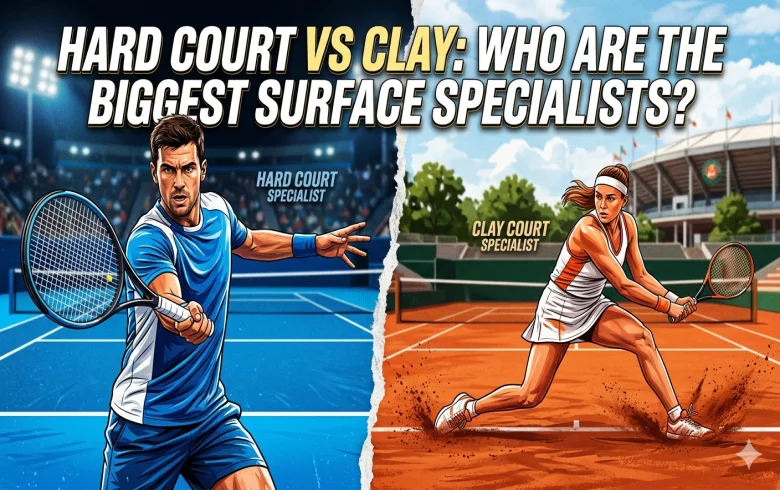
Rafael Nadal wins 91% of his matches on clay. Against the same opponents, he wins roughly 60% on hard courts. The difference is not fitness or tactics. It is the ground beneath his feet.
Surface specialism is one of the most powerful and most predictable patterns in professional tennis. Some players are structurally built for clay — their game style, movement, and shot selection thrive when the ball slows down and bounces high. Others are built for hard courts — their flat hitting, fast footwork, and serve dominate when the game accelerates. Understanding who thrives where is one of the most valuable edges in tennis prediction. This article profiles the biggest specialists on both surfaces and explains exactly what creates the gap.
Why Surface Specialism Exists — The Physics Behind the Gap
Clay and hard courts are not simply different colours of the same game. They produce fundamentally different physical environments. Clay slows the ball by roughly 25–30% compared to hard courts, produces a higher bounce, allows players to slide into shots, and favours long, physically punishing baseline rallies. Hard courts are faster, the bounce is lower and more predictable, the game is more serve-dominated, and explosive first-strike tennis is more effective.
These physical differences create structural advantages and disadvantages for different player types. A player with heavy topspin benefits enormously on clay — the high bounce amplifies their weapon. A flat hitter loses that same advantage when the ball stops bouncing up. A powerful server gains on hard courts — the fast surface extends the natural advantage of a dominant serve. On clay, even 130mph serves can be handled more easily because the ball slows and sits up.
Clay Court Slower, higher bounce, slide, longer rallies | VS | Hard Court Faster, lower bounce, first-strike, serve dominant |
The result is a statistical phenomenon that shows up across careers: most players win significantly more matches on one surface than the other. The players profiled below represent the extreme ends of that spectrum — and understanding their profiles is the foundation of smart surface-adjusted prediction.
The Greatest Clay Court Specialists (ATP)
These are the players whose games are structurally optimised for clay — and who pay a visible statistical price on hard courts.
Rafael Nadal - Spain |
Clay: ~91% | Hard: ~61% | Gap: +30% (clay dominant) The ultimate clay specialist. Nadal's extreme topspin forehand produces a kick that bounces shoulder-high on clay — well above the strike zone of most opponents. His defensive movement on clay is elite, and his endurance in extended baseline battles is unmatched in the history of the sport. On hard courts, the same topspin forehand is easier to handle because the bounce is lower and more predictable. Opponents can set up more comfortably, and Nadal's serve — solid but not dominant — becomes relatively more important in a surface environment that rewards it less. Prediction rule: On clay, Nadal is among the heaviest favourites the sport has ever seen, regardless of opponent ranking. On hard courts, particularly fast hard courts, treat him as competitive but not structurally dominant. |
Casper Ruud - Norway |
Clay: ~76% | Hard: ~57% | Gap: +19% (clay dominant) Ruud is the clearest modern example of a clay-built player in the post-Nadal generation. He grew up training in Nadal's academy in Mallorca, and his game — heavy topspin baseline play, exceptional clay movement, high physical endurance — reflects that environment completely. On hard courts, Ruud is competitive at the top-50 level but rarely a genuine title contender at Masters events. His flat groundstrokes are less effective on faster surfaces, and his serve does not generate the free points needed to control hard court matches from the box. Prediction rule: On clay, Ruud is consistently underrated by betting markets that rely too heavily on overall ranking. On hard courts, his ranking overstates his threat level. |
Nicolas Jarry - Chile |
Clay: ~74% | Hard: ~54% | Gap: +20% (clay dominant) Jarry combines a powerful serve with excellent clay court movement — an unusual combination that makes him particularly dangerous on clay. He uses the serve to create short balls and then constructs with his clay-optimised groundstrokes rather than going for outright winners. On hard courts, the combination works less effectively. His movement is less special on a faster surface, and without the clay's ability to turn pace into kickback, his groundstrokes lose much of their threat. Prediction rule: A significant market value opportunity on clay. Betting markets consistently underweight Jarry's clay credentials relative to his overall ranking. |
Win rate figures are approximate career averages. All ATP stats based on published ATP Tour records and Tennis Abstract data.
The Greatest Hard Court Specialists (ATP)
These are the players whose games thrive when the game is faster, the serve matters more, and explosive first-strike tennis dominates.
Jannik Sinner - Italy |
Clay: ~71% | Hard: ~85% | Gap: +14% (hard dominant) Sinner is the defining hard court specialist of his generation. His flat, clean ball-striking is perfectly calibrated for fast hard courts — he takes the ball early, drives through it with tremendous pace, and rarely allows opponents to reset. His serve has become elite, and his movement on hard courts is exceptional. On clay, Sinner is still a top-10 player — but structurally less dominant. The slower surface gives opponents time to reset; his flat groundstrokes generate less kick than topspin-heavy clay specialists, and his serve advantage is reduced. His clay-to-hard gap is one of the clearest surface-specialist profiles in tennis today. Prediction rule: On hard courts, Sinner is among the strongest favourites in the world — his Elo on hard courts is significantly higher than his overall ranking suggests. On clay, reduce expectations accordingly and look for clay specialists as potential upsets. |
Daniil Medvedev - Russia |
Clay: ~59% | Hard: ~78% | Gap: +19% (hard dominant) Medvedev's game was built entirely around hard courts. His flat, low-trajectory groundstrokes are devastating when the ball stays low — the conditions on fast hard courts. His serve is elite on hard surfaces, and his ability to redirect pace makes him one of the best returners on the tour when the ball comes in low and fast. On clay, Medvedev's game falls apart structurally. The high bounce neutralises his flat groundstrokes, his movement deteriorates relative to clay-adapted opponents, and his serve generates far fewer free points. He has been open about the fact that clay is not his surface, and the statistics confirm this emphatically. Prediction rule: Medvedev is among the most extreme surface specialists in professional tennis. His clay-to-hard gap of nearly 20% is one of the largest on tour. Back him aggressively on hard courts; treat any clay match with significant caution. |
Alexander Zverev - Germany |
Clay: ~72% | Hard: ~78% | Gap: +6% (slight hard preference) Zverev is more of a hard court specialist than a balanced player, though his gap is less extreme than Medvedev or Sinner. His serve — one of the most powerful on tour — functions at maximum effectiveness on hard courts, and his flat ball-striking benefits from the consistent, predictable hard court bounce. On clay, Zverev is still a top-five threat — his overall quality is too high to be dismissed — but he wins fewer big titles and performs slightly below his ranking would suggest. The clay season consistently produces close losses that hard courts would not. Prediction rule: On hard courts, especially at the Masters 1000 events, Zverev is a genuine title contender. On clay, he is formidable but slightly overrated relative to his overall ranking. |
Win rates are approximate career averages. Player profiles reflect career-level tendencies, not specific recent form.
Surface Specialists in Women's Tennis (WTA)
The WTA shows equally strong surface specialism patterns. Here are the most prominent examples from the current generation.
Iga Swiatek - Poland |
Clay: ~91% | Hard: ~80% | Gap: +11% (clay dominant) Swiatek's clay dominance mirrors Nadal's in its consistency and statistical weight. Her heavy topspin game, exceptional sliding, and relentless baseline play are perfectly suited to clay. At Roland Garros, she has been the closest thing to an automatic result in modern tennis. On hard courts, Swiatek is still the world's best player — but the margin compresses. Her dominance on hard courts, while exceptional in absolute terms, is clearly smaller than on clay. Opponents on hard courts can set up more comfortably against her heavy game. Prediction rule: On clay, Swiatek is the overwhelming favourite in almost any match. On hard courts, she is still the favourite, but the match is genuinely more open — include surface adjustment in any Swiatek prediction. |
Aryna Sabalenka - Belarus |
Clay: ~73% | Hard: ~84% | Gap: +11% (hard dominant) Sabalenka is Swiatek's structural opposite. Her game — powerful flat hitting, dominant serve, aggressive first-strike tennis — is optimised for hard courts. The Australian Open and US Open are her natural environments, and her results on hard courts are consistently at an elite level. On clay, Sabalenka is dangerous but not dominant. Her flat groundstrokes are easier to handle on the high-bouncing clay surface, and the slower pace gives opponents more time against her power game. She has shown improvement on clay over recent seasons, but the gap remains real and statistically significant. Prediction rule: On hard courts, Sabalenka is one of the heaviest favourites in the WTA. On clay, she is competitive, but the surface-adjusted predictions should reflect the reduced dominance — especially against clay specialists. |
WTA win rates are approximate career averages. Current form and recent surface results should always be checked before applying historical averages.
The Dual-Surface Elite — Players Who Thrive Everywhere
A rare subset of players maintains genuinely elite win rates across both clay and hard courts. These players are the hardest to predict against because surface adjustment provides less edge.
Novak Djokovic - Serbia DUAL-SURFACE ELITE |
Clay: ~86% | Hard: ~87% | Gap: ~1% Djokovic is the greatest evidence that surface specialism can be overcome by sufficiently elite all-round quality. His career win rates on clay and hard courts are essentially identical at the highest level — an extraordinary achievement across surfaces that are physically very different. His movement adapts to both conditions, his return game is elite everywhere, and his serve is solid enough not to be a weakness on any surface. For prediction purposes, Djokovic is the benchmark against which surface specialists are tested. A clay specialist facing Djokovic on clay has less of an advantage than they would against most hard court players, because Djokovic's clay win rate is elite. The surface gap simply does not exist for him the way it does for almost everyone else. Prediction rule: Surface adjustment is minimal for Djokovic. His overall Elo is the primary predictor — the surface does not significantly change the expected outcome. |
Carlos Alcaraz - Spain DUAL-SURFACE ELITE |
Clay: ~82% | Hard: ~80% | Gap: ~2% Alcaraz is the rare combination of clay upbringing and hard court physicality. His game — explosive movement, heavy topspin, elite serve — works on both surfaces with only minor style adjustments. He is the only current player in the men's game who challenges Djokovic for the dual-surface elite classification. The prediction challenge with Alcaraz is that his surface profile changes very little — which means the primary variables are form, opponent quality, and draw path rather than surface adjustment. He is slightly more dominant on clay (where his topspin is amplified) but genuinely threatening on hard courts as well. Prediction rule: Surface adjustment for Alcaraz is small but real — favour him slightly more on clay. The bigger variables are form and draw. |
Surface Gap Analysis — The Biggest Differentials on Tour
This table shows the approximate surface gap for key players, ranked by the size of the differential between clay and hard court performance.
Player | Clay Win Rate | Hard Win Rate | Gap & Classification |
Rafael Nadal (ATP) | ~91% | ~61% | Large gap — extreme clay specialist |
Daniil Medvedev (ATP) | ~59% | ~78% | Large gap — extreme hard court specialist |
Casper Ruud (ATP) | ~76% | ~57% | Large gap — clear clay specialist |
Nicolas Jarry (ATP) | ~74% | ~54% | Large gap — clear clay specialist |
Jannik Sinner (ATP) | ~71% | ~85% | Medium gap — strong hard court specialist |
Iga Swiatek (WTA) | ~91% | ~80% | Medium gap — clay dominant, still elite on hard |
Aryna Sabalenka (WTA) | ~73% | ~84% | Medium gap — clear hard court specialist |
Alexander Zverev (ATP) | ~72% | ~78% | Small gap — slight hard court preference |
Novak Djokovic (ATP) | ~86% | ~87% | Small gap — genuine dual-surface elite |
Carlos Alcaraz (ATP) | ~82% | ~80% | Small gap — dual-surface elite |
All win rates are approximate career-level averages. Players with fewer career matches on one surface will show more volatile figures. Always cross-reference with the recent form.
The Surface Specialist Prediction Table — Who Has the Edge Where
Use this framework when two players with different surface profiles meet on clay or hard courts.
Matchup Type | Clay | Hard Court | What the Surface Does |
Clay specialist vs Hard specialist | Clay favourite — large edge | Hard court favourite — large edge | Surface completely determines the structural favourite. |
Clay specialist vs All-rounder | Clay favourite — moderate | Evenly matched — slight hard edge | Clay erases most of all-rounder's advantage; hard restores it. |
Hard specialist vs All-rounder | Evenly matched — slight clay | Hard court favourite — moderate | Hard courts amplify the specialist's structural advantage. |
Dual-surface vs Clay specialist | Evenly matched | Hard court favourite — moderate | Dual-surface players struggle less on clay than most hard specialists. |
Dual-surface vs Hard specialist | Clay favourite — slight | Evenly matched | Hard specialist's home turf advantage is reduced by dual-surface quality. |
Two clay specialists | Evenly matched — form decides | Hard court favourite for a higher-ranked | On neutral surfaces, ranking and form carry more weight. |
Two hard specialists | Hard court favourite for a higher-ranked | Evenly matched — form decides | Same as above, but inverted. |
This table assumes both players are in similar form. Surface edges are reduced (but not eliminated) when one player is significantly higher ranked.
What Creates a Surface Specialist — The Technical Factors
Surface specialism is not random. It emerges from specific technical patterns in a player's game. Here are the factors that most strongly produce a clay or hard court advantage:
- Topspin forehand weight: Heavy topspin generates a higher kick on clay, amplifying the shot's effectiveness. On hard courts, the same ball bounces more predictably and can be absorbed. Clay specialists almost universally rely on heavy topspin as their primary weapon.
- Serve speed and flatness: Fast, flat serves lose more value on clay because the surface slows them and raises them into a comfortable return position. The serve advantage is amplified on hard courts, where the ball stays low and fast. Hard court specialists tend to have more dominant serves.
- Movement style: Clay allows sliding — a technique that lets players chase down wide balls without losing balance. Players who have developed a sliding movement pattern from a young age are structurally better suited to clay. Hard court movement is more explosive and stop-and-start.
- Rally length tolerance: Clay produces longer rallies by design. Players who thrive in extended physical exchanges gain on clay. Players who prefer short, aggressive points — using the serve and first strike — gain on hard courts.
- Ball speed preference: Flat hitters who drive the ball through the court at low trajectory are less effective on clay, where the high bounce moves the ball away from their strike zone. Topspin players find the opposite dynamic on hard courts.
💡 The prediction shortcut: Look at a player's forehand — heavy topspin with high kick means clay advantage. Flat, driving groundstrokes mean hard court advantage. This single technical indicator explains roughly 60–70% of the surface gap for most players. |
How to Use Surface Specialism in Match Predictions
Here is a practical step-by-step framework for applying surface specialism data to your match predictions:
- Identify each player's surface type. Clay specialist, hard court specialist, or dual-surface? Use career win rates on each surface to classify — a 10%+ gap between surfaces is a meaningful specialisation signal.
- Weight recent surface form more heavily than career averages. A clay specialist who has been playing well on hard courts in recent weeks carries more momentum than their career statistics alone suggest.
- Use surface-specific Elo ratings where available. These capture current-form surface performance better than raw win rates, which can be dominated by older results.
- Adjust for the size of the gap. A 25%+ clay-to-hard differential (like Nadal's) is a massive prediction modifier. A 6% gap (like Zverev's) is a mild tilt. Scale your adjustment accordingly.
- Consider the draw path. A clay specialist reaching the quarter-finals of a clay tournament may be peaking — their surface advantage compounds with match sharpness. A hard specialist forced through the clay draw to reach the same point may be fatigued.
- Look for market inefficiencies. Betting markets often price players on overall ranking, not surface-specific credentials. When a clay specialist faces a hard court player on clay, and the market treats them as equal, that is value.
💡 The golden rule: Always ask 'what does this surface do to these two players' game styles?' before finalising any prediction. Surface is not just a background variable — it actively transforms who the favourite is. |
The Bottom Line
Hard court vs clay is not a minor tactical consideration — it is the single biggest structural variable in professional tennis. The same player can be a near-unbeatable juggernaut on one surface and a credible upset candidate on another. Nadal on clay and Medvedev on clay are not the same player in any meaningful sense: they just happen to share a ranking bracket. The biggest surface specialists in modern tennis — Nadal, Ruud, and Swiatek on clay; Sinner, Medvedev, and Sabalenka on hard courts — represent extreme versions of patterns that run through every player on tour. Recognising and quantifying those patterns is one of the most reliable sources of predictive edge in tennis analytics.
Frequently Asked Questions
❓ Who is the biggest clay court specialist in tennis history?
Rafael Nadal is the most extreme surface specialist ever recorded in professional tennis. His career clay win rate of approximately 91% is unmatched in the Open Era, and his clay-to-hard gap of roughly 30 percentage points dwarfs every other player on record.
❓ Who is the biggest hard court specialist currently playing?
Daniil Medvedev holds the clearest hard court specialism in current professional tennis, with a clay win rate roughly 19–20 percentage points below his hard court average. Jannik Sinner is the next clearest, with a 14-point differential and a hard court Elo that significantly exceeds his clay performance.
❓ Does surface specialism affect Grand Slam predictions?
Yes, enormously. Roland Garros heavily favours clay specialists — and routinely produces results that look shocking on ranking but are entirely predictable through surface Elo. The Australian Open and US Open (hard courts) tend to produce results that align more closely with overall ranking because hard courts are the most neutral surface.
❓ Can a player overcome their surface disadvantage with ranking?
Partially. A player ranked much higher can still win on their weaker surface — but the surface gap erodes their win probability significantly. A top-5 player with a 60% hard court win rate who faces a top-30 player with an 80% hard court win rate on hard courts is a less heavy favourite than their ranking suggests.
❓ How do surface-specific Elo ratings capture specialism?
Surface-specific Elo ratings calculate a separate performance score using only results from that specific surface. They adjust automatically for opponent quality and update after every match. This makes them far more sensitive to surface specialism than overall rankings, which average across all surfaces.