Roland Garros Upset History — What the Data Reveals
Published on 07 May 2026 | Last updated on 01 Jul 2026 | Reading time: 15 minutes
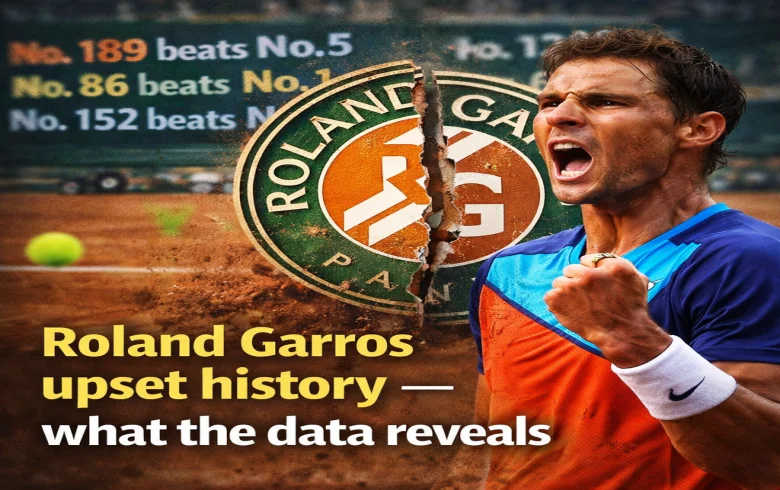
Roland Garros is the Grand Slam with the most obvious dominant force in tennis history — and yet, paradoxically, it is also the tournament that has produced some of the most staggering upsets ever seen on a court. Rafael Nadal's 14 titles here, including a stretch where he went four years between losses on this clay, created the impression that Roland Garros is predictable. The data tells a more complicated story.
If you strip out the Nadal era and look at the full sweep of Roland Garros history, one truth emerges clearly: the red clay of Paris does not protect the favourites. Clay rewards endurance, topspin, and tactical patience — but it also amplifies fatigue, exposes players who are not fully adapted to the surface, and creates conditions where a red-hot qualifier can beat a world number one. It has happened. Multiple times. In multiple eras.
This guide examines the biggest upsets in Roland Garros history, breaks down the data patterns that predict when they happen, and gives you the tools to identify the next one before it occurs.
⚡ The Key Question Is Roland Garros more or less predictable than the other Grand Slams? The answer is nuanced: the top of the draw is often very predictable (top seeds dominate, especially clay specialists). But the first two rounds and the quarter-finals regularly produce results that defy rankings by a significant margin. |
Why Upsets Happen at Roland Garros
Before examining the specific matches, it helps to understand the structural reasons why Roland Garros generates upsets at all — because clay is theoretically the surface that most rewards the superior player.
Five sets on heavy clay is a great equalizer
The men's draw at Roland Garros is best-of-five. On clay, with long, physical rallies, a five-set match can stretch to four or five hours. A world number two who is slightly tired, slightly off-form, or slightly mis-calibrated tactically will lose to a world number 35 who is in peak condition and prepared to grind. The surface does not reward the better player in short bursts — it rewards the better player on that specific day, over that specific duration.
The clay-court specialist effect
The rankings are dominated by all-surface players because hard courts dominate the calendar. But Roland Garros specifically rewards clay-court movement, slide technique, heavy topspin, and the ability to construct long points. A player ranked 45 who has spent their entire career on clay can be structurally superior to a player ranked 8 who spends eight months a year on hard courts. The ranking gap tells you nothing about clay-specific ability.
Aggressive flat-ball players can dismantle the favourites
Clay's conventional wisdom says topspin wins. But there is a counter-argument: a flat-ball, big-hitting, aggressive player who does not allow the opponent to construct points — Soderling being the ultimate example — can disrupt even the most accomplished clay courters by removing the time they need to build their preferred patterns. This type of upset is particularly difficult to predict because it requires the aggressive player to maintain an extraordinary level for an entire match.
Fatigue accumulates across the season
Roland Garros arrives at the end of a long clay swing: Monte Carlo, Barcelona, Madrid, Rome, then Paris. Players who make deep runs in the weeks before — especially those who played in the Rome or Madrid finals — arrive in Paris physically depleted. This is why upsets are disproportionately common in the first three rounds, as tired favourites face opponents who rested for two weeks.
⚠️ Prediction Warning A player who reached the final of Rome or Madrid in the two weeks before Roland Garros is statistically more likely to underperform in the early rounds at Paris, regardless of their ranking. Fatigue factor when assessing odds for round one and two favourites. |
The Greatest Upsets in Roland Garros History — Ranked
1. Robin Soderling defeats Rafael Nadal (2009, R4)
This is the greatest upset in Roland Garros history — and arguably one of the greatest in the history of Grand Slam tennis. Entering the match, Nadal was 31-0 at Roland Garros. He had won the previous four editions. He had beaten Soderling 6-1, 6-0 on clay in Rome just weeks earlier. Soderling was seeded 23rd and had never gone past the fourth round of a major.
Stat | Detail |
Year & Round | 2009 French Open, Round of 16 (Fourth Round) |
Winner / Loser | Robin Soderling (No.23 seed) def. Rafael Nadal (No.1 seed) |
Score | 6-2, 6-7(2), 6-4, 7-6(2) |
Nadal's record before | 31-0 at Roland Garros, 4-time defending champion |
Soderling's record | Had never passed R4 of any major |
Nadal's pre-match odds | Approx. 1.03 favourite (near certainty by betting markets) |
Soderling fired 61 winners vs Nadal's 33 — net points won: 27/35 | |
What happened next | Soderling reached the final; Federer won the title |
Soderling's tactic was brutally simple: hit the ball hard and flat, attack Nadal's topspin before it could kick up above shoulder height, and approach the net at every opportunity. He went for winners on nearly every shot. The aggression was so relentless that Nadal — whose game is built on absorbing pace and redirecting it — never found a rhythm. Soderling won 61 winners against Nadal's 33. He won 27 of 35 net points. And he changed tennis history.
"I felt pretty good coming into that match because I had nothing to lose and nobody expected me to win." — Robin Soderling, after defeating Rafael Nadal at Roland Garros 2009 |
2. Michael Chang defeats Ivan Lendl (1989, R4) — then wins the tournament
Seventeen-year-old Michael Chang entered Roland Garros as the 15th seed. Lendl was a three-time French Open champion and heavy favourite. Chang was cramping badly in the fourth set and started hitting underhand serves to deceive the Czech, who was visibly rattled. Chang won in five sets and went on to win the entire tournament — becoming the youngest men's Grand Slam champion in Open Era history at 17 years, 3 months, and 20 days.
Stat | Detail |
Year & Round | 1989 French Open, Round of 16 (Fourth Round) |
Winner / Loser | Michael Chang (15th seed, aged 17) def. Ivan Lendl (No.1 seed) |
Score | 4-6, 4-6, 6-3, 6-3, 6-3 |
Tournament result | Chang went on to WIN Roland Garros |
Key detail | Chang used underhand serves and gamesmanship while suffering cramps |
Historic record | Youngest men's Grand Slam champion in Open Era history |
3. Novak Djokovic defeats Rafael Nadal (2021, SF)
By 2021, Nadal had won four consecutive French Opens (2017-2020) and held a 105-2 career record at Roland Garros. Djokovic had never beaten Nadal in Paris in four previous meetings. The semi-final match was widely regarded as one of the greatest matches ever played at Roland Garros. Djokovic recovered from a slow start to win 3-6, 6-3, 7-6(4), 6-2, becoming only the second player in the Open Era to beat Nadal at Roland Garros.
Stat | Detail |
Year & Round | 2021 French Open, Semi-Final |
Winner / Loser | Novak Djokovic def. Rafael Nadal |
Score | 3-6, 6-3, 7-6(4), 6-2 |
Nadal's record at point of match | 105-2 career record at Roland Garros |
Djokovic's record vs Nadal at RG | 0-4 in previous meetings at Roland Garros |
Significance | Only the 2nd player to beat Nadal at RG in the Open Era |
4. Marco Cecchinato defeats Novak Djokovic (2018, QF)
Cecchinato was ranked 72nd in the world and had never won a Grand Slam match before Roland Garros 2018. Djokovic, the 2016 French Open champion, was the clear favourite. Cecchinato not only beat him but did it in four sets, becoming the lowest-ranked player in a Roland Garros semi-final since 1999. Djokovic led 5-4 in the fourth-set tiebreak, but Cecchinato saved two match points to win 13-11.
Stat | Detail |
Year & Round | 2018 French Open, Quarter-Final |
Winner / Loser | Marco Cecchinato (72nd in the world) def. Novak Djokovic (No.12 seed) |
Score | 6-3, 7-6(4), 1-6, 7-6(13-11) |
Context | Cecchinato had NEVER won a Grand Slam match before this tournament |
Tiebreak drama | Djokovic led 5-4 in the final tiebreak; Cecchinato saved 2 match points |
Historic result | First Italian in a Grand Slam semi-final since 1978 |
5. Thiago Seyboth Wild defeats Daniil Medvedev (2023, R1)
Medvedev, the world number two and 2021 US Open champion, entered Roland Garros as a heavy favourite in round one. Seyboth Wild was a qualifier — he had snuck into the draw through qualifying — making his first-ever Grand Slam main draw appearance. Despite Medvedev winning two sets and seeming in control, Seyboth Wild's clay-court game and never-say-die attitude pulled off the five-set win. The betting line had Seyboth Wild at 15.00 (14/1).
Stat | Detail |
Year & Round | 2023 French Open, Round 1 |
Winner / Loser | Thiago Seyboth Wild (qualifier) def. Daniil Medvedev (No.2 seed) |
Score | 7-6(5), 6-7(6), 2-6, 6-3, 6-4 |
Odds | Seyboth Wild 15.00; Medvedev 1.14 (approx.) |
Context | Seyboth Wild's first ever Grand Slam main draw match |
Pattern | Medvedev historically struggles at Roland Garros — clay court weakness exposed |
6–10: Five More That Changed Everything
Year / Match | Seed Gap | Why It Matters |
1993 R1: Arnaud Huet def. Ivan Lendl | 297 vs seed 6 | Lendl lost to a player ranked 297 in his Roland Garros debut. Career contrast: Lendl 1,027 wins, Huet 0 ATP wins before this. |
1983 R4: Kathy Horvath def. Martina Navratilova | Unseeded vs No.1 | Navratilova was 36-0 in 1983, won 3 Slams. Her only major loss that entire year. |
2004 R2: Tathiana Garbin def. Justine Henin | 86 vs No.1 | Henin was the defending champion but had been ill for 6 weeks. Shows how fatigue/illness collapses favourites. |
2012 R1: Virginie Razzano def. Serena Williams | 111 vs No.1 | Only time in Serena's career she lost in R1 of a Grand Slam. Williams led 5-1 in 2nd-set tiebreak. |
2014 R2: Guillermo Garcia-Lopez def. Stan Wawrinka | 41 vs No.3 | Wawrinka was the Australian Open champ & Monte Carlo winner. Garcia-Lopez won 6-4, 5-7, 6-2, 6-0 in 2h23m. |
What the Data Reveals: Patterns in Roland Garros Upsets
When you step back from the individual matches and look at the full sweep of Roland Garros history, distinct patterns emerge that are directly useful for making better predictions.
Pattern 1: Round 1-3 is where the chaos lives
The vast majority of major upsets at Roland Garros — where a lower-ranked player beats a significantly higher-ranked opponent — happen in the first three rounds. By the quarter-finals, the clay specialists have typically asserted themselves. The first week is where tired favourites, clay-court misfits, and red-hot qualifiers collide.
Round | Upset Frequency | Main Cause |
Round 1 | High | Clay-court mismatch, fatigue from clay swing, opponent peaked |
Round 2 | Moderate-High | Continued fatigue, first-round confidence for upset winners |
Round 3 | Moderate | First week survivors; tired seeds face rested qualifiers |
Round 4 (R16) | Low-Moderate | Biggest individual upsets (Soderling 2009, Djokovic 2021 SF) |
Quarter-Final | Low | Clay specialists dominate; Cecchinato 2018 is the exception |
Semi-Final | Very Low | Only elite clay courters reach this stage |
Final | Extremely Low | Almost always two top seeds or clay specialists |
Pattern 2: Non-clay-specialists are chronically overvalued
The clearest data pattern across Roland Garros history is this: players whose ranking comes primarily from hard court results — American and Northern European players especially — are consistently overvalued at Roland Garros. At the same time, Spanish players, Italian players, and South American clay-court specialists are consistently undervalued because their clay results are given equal weight with hard court results in ranking calculations.
This creates a structural betting value: if a Spanish clay specialist ranked 30th faces an American hard-court player ranked 12th at Roland Garros, the ranking gap exaggerates the American's advantage. The clay-specific records often tell a completely different story.
Pattern 3: The big-flat-ball disruptor profile
The Soderling upset — and others like it — follow a distinct tactical profile. The upset always involves a player with a big, flat serve and aggressive groundstrokes who attacks on every ball and prevents the favourite from establishing a defensive rhythm. Against topspin-heavy favourites, this disruption is particularly effective because it removes the one thing those players need: time.
When you see this match-up — flat-ball, big-serving aggressive player vs a pure clay-court grinder — treat it with extra caution regardless of the ranking differential.
Pattern 4: Medvedev is the poster child for clay vulnerability
Daniil Medvedev has failed to win a single match in the first round at Roland Garros in five of his seven appearances. He is a player whose game — flat, fast, low-bouncing hard court tennis — simply does not translate to clay. His ranking, consistently inside the top 5, dramatically overstates his Roland Garros prospects. This pattern has been visible for years, and yet each spring the market prices him as a genuine contender.
The broader lesson: any player who structurally struggles on clay (flat ball strikers, poor sliders, hard-court-dominant rankings) will be overvalued at Roland Garros regardless of their current world ranking.
Pattern 5: The underdog with nothing to lose
At Roland Garros specifically, qualifiers and low-seeded players have produced a disproportionate number of memorable runs. Seyboth Wild (2023), Cecchinato (2018), Soderling (2009), and Chang (1989) — all were players with nothing to lose, playing with the freedom that comes from being completely written off. This psychological dynamic is amplified on clay, where long rallies give underdogs time to find their rhythm, and where physical condition can narrow the gap between a ranked 70 player in peak form and a top-5 seed who has been travelling and competing for three months.
💡 Prediction Rule At Roland Garros, treat any non-clay-specialist ranked in the top 10 as potentially overvalued. Use clay-specific head-to-head records. Watch for qualifiers and late-round qualifiers who have had time to rest and prepare specifically for Paris clay. |
The Profiles Most Likely to Cause Upsets in 2026
Based on historical patterns, here are the player types most likely to produce the next Roland Garros shock:
- Type 1: Hard-court dominant players outside the top 5 — Medvedev, Fritz, Shelton. History says these players will underperform relative to their ranking at Roland Garros. Any opponent with a strong clay game is undervalued against them.
- Type 2: Tired top-3 seeds — Any player who reached the Rome or Madrid final in the two weeks before Paris. Physical depletion is the hidden variable that betting markets never fully price in.
- Type 3: Spanish or Italian clay specialists in the 20-50 range — These players are structurally undervalued at Roland Garros. They have clay-specific movement, preparation, and tactical knowledge that their overall ranking does not reflect.
- Type 4: Red-hot qualifiers — A qualifier who wins three qualifying rounds then starts the main draw is in peak competitive condition, playing without pressure, and has often been on Paris clay for two weeks. This is Soderling's profile before he beat Nadal.
- Type 5: Players peaking in the draw — Cecchinato 2018, Seyboth Wild 2023, Soderling 2009 all shared one thing: they were playing the best tennis of their lives during that specific two-week window. Hot streaks on clay are unusually persistent because the surface rewards physical form.
Roland Garros Upset Prediction Checklist — 2026 | |
Surface Record | Check clay-specific win %. Ignore hard court results for Roland Garros assessment. |
Pre-Tournament Fatigue | Did the favourite play the Rome or Madrid final? Higher upset risk in R1-R3. |
Flat Ball / Clay Mismatch | Does the favourite rely on flat, fast ball striking? Their game is structurally disadvantaged. |
Qualifier Status | Any qualifier with 2+ weeks on Paris clay is dangerous regardless of ranking. |
Upset Profile Match | Aggressive flat-ball player vs topspin grinder = historically elevated upset probability. |
Head-to-Head on Clay | Overall, H2H is less useful than H2H specifically on clay. Check this separately. |
Home Nation Factor | French players often overperform at Roland Garros. Portuguese, Spanish, and Italian names in the 30-70 range are undervalued. |
In-Tournament Form | After round 3, players who have won convincingly in a short time are often in better shape than high seeds grinding through long matches. |
The Lesson Roland Garros History Teaches
The data from decades of Roland Garros reveals a tournament that is simultaneously more predictable and less predictable than it appears. More predictable at the top: the clay specialists — historically Nadal, now Alcaraz — tend to get through the first week with minimal drama and dominate the second week. Less predictable in the middle: rounds one through four regularly produce matches where ranking is a poor guide, where fatigue, clay-specific skill, and individual form on a given day override the pre-match hierarchy.
The clearest lesson for prediction is the clay specialist premium. At Roland Garros, adjust every match-up to account for clay-specific ability, not just overall ranking. A player ranked 40 who has spent their career on clay and loves Roland Garros is a genuinely different opponent from a player ranked 40 who primarily plays on hard courts. The surface is the great equalizer — and the data backs it up.
The second lesson is the value of surprise form. Some of the biggest upsets in Roland Garros history came from players who were not just good enough — they were in the form of their lives during that specific fortnight, and the clay surface allowed that form to persist long enough to beat a better player. Identifying these players before the upset happens is the skill — and the historical profiles give you the template.
Conclusion
Roland Garros upset history reveals five consistent patterns: (1) R1-R3 is the danger zone for favourites; (2) non-clay-specialists are chronically overvalued; (3) the flat-ball aggressor is the classic upset profile; (4) fatigue from the clay swing is the hidden variable; (5) qualifiers and hot streakers are undervalued. Apply these patterns to 2026, and you will find value that the market misses.