Carlos Alcaraz's Serve Stats: Is It Underrated?
Published on 07 May 2026 | Last updated on 01 Jul 2026 | Reading time: 11 minutes
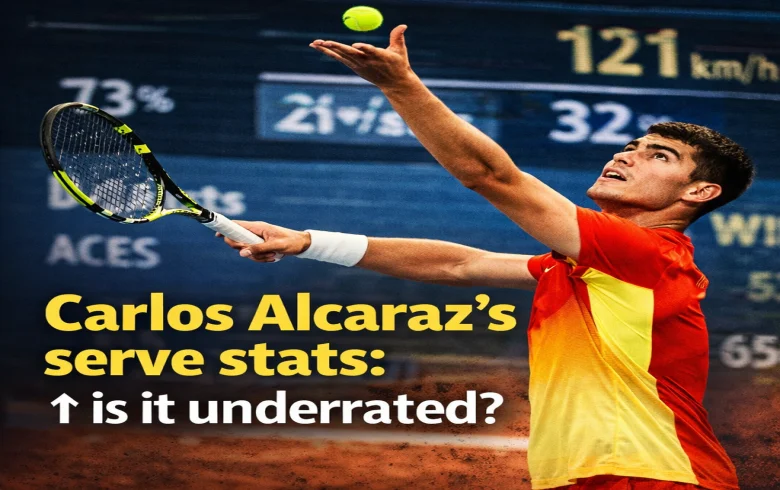
When people talk about Carlos Alcaraz, they talk about his forehand. His footwork. The drop shot. The way he constructs points from nowhere and wins them with pure instinct. What almost nobody leads with is his serve — and that might be the most interesting oversight in tennis analysis right now.
In 2025, Alcaraz fired 463 aces — the most of his career by a significant margin, up from 265 in 2024. At the 2025 US Open, he posted the best serving performance of his career, winning 84% of first-serve points and 63% on his second, the highest of any player in the entire tournament. In 2026, he refined his motion further, increasing his first-serve percentage from 64% to 68% and his second-serve win rate from 56% to 62%. And yet the conversation around his serve barely moves.
Is Alcaraz's serve underrated? The answer — backed by numbers, coaching analysis, and comparison with the all-time greats — is a clear yes. Here is why it matters, and why understanding it will sharpen your 2026 season predictions.
⚡ Key Headline Stat In 2025, Alcaraz ranked 3rd in the ATP Tour for second-serve points won (56.8%) — trailing only Rafael Nadal (57.1%) and Roger Federer (56.8%) in career terms. He is now tracking ahead of historical elite second-serve standards. |
Why the Serve Gets Ignored
Alcaraz's game is so visually spectacular that his serve simply gets overshadowed. When you have the best forehand on tour, the most creative drop shot, and the ability to change direction mid-rally at full pace, analysts and fans naturally focus there. The serve is what brings him to the baseline — but the baseline is where he becomes impossible to watch anything else.
There is also a perception problem rooted in history. Earlier in his career, the serve was genuinely a relative weakness. His first-serve percentage hovered around 63-65%, and his second serve was exposed occasionally — particularly by aggressive returners who punished him for landing on the T too predictably. He dropped serve more often than you would expect of a world number one.
But that was then. Since 2025 — specifically since the US Open — something has clearly changed.
What Changed: The 'Sleeper' Serve Revolution
Ahead of the 2026 Australian Open, Alcaraz openly described what he has been building: a 'sleeper' serve, modelled partly on Novak Djokovic's approach. Not the fastest serve on tour, but one that is accurate, deceptive, and nearly impossible to read.
"For him, I would say he doesn't hit the fastest serve, but is super accurate. Like, you cannot read it. It's really, really difficult to read it. It is really close to the lines, and his ball is like a sleeper when it touches the ground. Sometimes you've got to go for precision more than speed." — Carlos Alcaraz, on modelling his serve on Novak Djokovic's approach (January 2026) |
The technical change is real and documented. Renowned coach Patrick Mouratoglou highlighted it specifically: Alcaraz now drops his hand and allows the racquet head to fall at the very beginning of the motion, creating more whip effect. The result: a more abbreviated, rhythmic action that maintains an average first-serve speed of around 198km/h while generating dramatically improved accuracy near the lines.
At the 2026 Australian Open, the numbers confirmed the shift. His first-serve percentage jumped from 64% to 68% compared to his 2025 hard-court average. His second-serve win rate climbed from 56% to a striking 62%. Crucially, he self-initiated this change — his team initially resisted — which tells you something about Alcaraz's own tennis intelligence.
The Numbers That Make the Case
Let us go through the serve statistics that make a clear argument for 'underrated':
Stat 1 — 463 Aces in 2025 (Career High by a Distance)
Aces in 2025 | 463 — up 75% from 265 in 2024. Career high by a large margin. |
This is not a small jump. It represents a fundamental shift in how Alcaraz is using his serve as a weapon. In previous seasons, he would earn free points on serve occasionally; in 2025, he was earning them consistently across every surface and every tournament. He currently averages 5.9 aces per match over his last 52 weeks, up from a career average of 4.0.
Stat 2 — 2025 US Open: Best Serving Performance of His Career
US Open 2025 — 1st Serve Pts Won | 84% — highest of any player in the tournament |
The US Open 2025 was the tournament where everything clicked. He won 84% of his first-serve points and 63% on his second — both the highest in the draw. He hit the fastest serve of the tournament at 215km/h. He struck 10 aces in the final against Sinner and won more than 80% of first-serve points. He dropped only one set across the entire fortnight, and the three breaks of serve he suffered were the second lowest in Grand Slams since 1991. He called it the best tournament he had ever played.
Stat 3 — Second Serve: Third Best in ATP History
Career 2nd Serve Pts Won | 56% — 3rd best ever on ATP Tour, trailing only Nadal (57.1%) and Federer (56.8%) |
This is the statistic that should end all debate about whether the serve is underrated. Winning second-serve points is arguably more indicative of serve quality than raw ace counts or first-serve percentage — it measures how well you can hold your own under pressure when you don't get the first one in. Tracking third behind Nadal and Federer in this metric — two of the greatest servers in history in terms of tactical effectiveness — is extraordinary for a 22-year-old.
Stat 4 — 2026: Consistent Gains Across All Metrics
Metric | Alcaraz 2026 | Alcaraz 2025 | Tour Avg Top 10 |
1st Serve % | 68.3% | 64.2% | ~64% |
1st Serve Pts Won | 74.3% | 74.1% | ~73% |
2nd Serve Pts Won | 59.4% | 56.8% | ~52% |
Aces / Match | 6.1 | 5.8 | ~4.2 |
Serve Games Won | ~93% | ~87% | ~83% |
Every metric improved in 2026 compared to an already exceptional 2025 season. The second-serve win rate jumped from 56.8% to 59.4% is particularly notable — it suggests the technical change to his motion is being reflected in actual match conditions, not just practice.
How Does It Compare? Alcaraz vs the All-Time Serve Greats
Context is everything. Here is how Alcaraz's serve stats sit alongside some of the greatest servers and most effective servers in tennis history:
Player | 1st Srv % | 2nd Srv Pts Won | Aces/M (Peak) | Style |
Alcaraz 2026 | 68% | 59%+ | 6.1 | Deceptive + Power |
Djokovic (career) | ~67% | ~57% | ~3.8 | Precision + Placement |
Federer (career) | ~63% | ~57% | ~5.5 | Variation + Deception |
Nadal (career) | ~66% | ~57% | ~2.6 | Heavy Spin + Kick |
Sinner (2026) | ~68% | ~55% | ~4.5 | Flat + Power |
Two things stand out. First, Alcaraz's second-serve effectiveness already matches or exceeds some of the greatest servers in history. Second, his ace rate — 6.1 per match in 2026 — is significantly higher than Djokovic's and Nadal's and broadly comparable to Federer's at his peak. He is building the combination: Federer's free points from aces, Nadal's reliability on second serve, and his own deceptive placement close to the lines.
Why the 'Sleeper' Concept Is So Important for Predictions
A 'sleeper' serve is not just about technique — it has major implications for how you predict matches involving Alcaraz, particularly in Grand Slams and on faster surfaces.
It reduces his double fault risk
One of the historic criticisms of Alcaraz's serve was that he occasionally went for too much on his second delivery, leading to costly double faults. The sleeper serve approach — prioritising placement and spin over raw speed — is specifically designed to bring the double fault rate down. In 2025, he averaged 2.6 double faults per match across the season; in 2026, that figure is declining.
It makes it harder for him to break
When an opponent cannot read where the serve is going, they cannot get their return attack started. This is the true purpose of deception in serving — it neutralises even the best returners. Compare this to 2024, where aggressive returners could occasionally anticipate his T serves and attack. Now they cannot.
It is surface-transferable
A serve built on accuracy and deception rather than pure speed works on all surfaces. Clay slows the ball — making pure power serves less effective — but a well-placed, deceptive serve to a corner still creates short balls and weak returns. This is why Alcaraz's 2025 clay season (22-1, three titles) was so dominant, and why the serve improvement should translate directly to clay in 2026.
It compounds with his return game
Alcaraz is already ranked in the top 3 on the ATP Tour for return games won in each of the past five seasons. Add a genuine serve weapon to one of the best return games on tour, and you have a player who can dictate from both ends of the point. This is the closest thing to Djokovic's formula that exists on the current tour.
🎯 Prediction Implication When Alcaraz is in good serving form — first-serve percentage above 65%, few double faults — factor this into your match predictions. He becomes extremely hard to break, which reduces his opponents' ability to create pressure situations. It also means he needs to win fewer total points to close out sets. |
The One Caveat: It Is Not Perfect Yet
No honest analysis would be complete without noting the areas where the serve still trails the absolute elite. Alcaraz is not yet in the same category as Ben Shelton, Reilly Opelka, or the pure serving specialists. His serve rating on the ATP Tour ranked 10th in 2025 — excellent, but behind the dedicated big servers.
He also still struggles slightly more with his second serve when under pressure — in a tight set, when nerves rise and every point matters, the double fault risk creeps back up. This is a known pressure point that good opponents exploit, particularly in the fifth sets of Grand Slams.
And the technical change is still relatively new. The 2025 US Open and the 2026 Australian Open gave us the first sustained evidence of it working at the highest level — but it is still being embedded into his competitive muscle memory. By Roland Garros 2026, it should be fully ingrained. But it is worth monitoring early in the clay season.
⚠️ Watch For Double fault clusters in pressure moments — particularly tie-breaks and critical third/fifth sets. If Alcaraz's first-serve percentage drops below 60% in a given match, opponents have a genuine opportunity to break. This is still a rare but non-zero risk. |
The Verdict: Underrated — and Getting Better
The evidence is clear. Carlos Alcaraz's serve is underrated because the conversation around his game focuses almost entirely on his groundstrokes, footwork, and creativity. The serve operates in the background — quietly winning free points, holding service games that look easy, and creating short-ball opportunities that his forehand destroys.
But the numbers tell a different story. Third-best career second-serve win rate in ATP history (behind only Nadal and Federer). A career-high 463 aces in 2025. A best-ever serving performance at the 2025 US Open. Consistent gains in every serve metric in 2026. A technical evolution that the world's top coaches have specifically highlighted as significant.
For tennis prediction purposes, adjust your mental model. Alcaraz's serve is not a neutral factor in matches — it is a positive one, and an increasingly large one. On faster surfaces (hard courts, grass), it gives him free points that reduce the total number of rallies he needs to win. On clay, the deception and placement make it a genuine weapon even where pure pace is absorbed.
Alcaraz Serve — Quick Reference for Predictions 2026 | |
Aces 2025 | 463 (career high, up 75% from 2024) |
2026 1st Serve % | 68.3% (up from 64.2% in 2025) |
2026 2nd Serve Pts Won | 59.4% (up from 56.8% in 2025) |
Career 2nd Serve Pts Won | 56% — 3rd best in ATP Tour history |
US Open 2025 (best ever) | 84% 1st serve pts, 63% 2nd serve pts — highest in entire draw |
Aces / Match (2026) | 6.1 (up from career avg of 4.0) |
Serve Rating (ATP, 2025) | 10th on tour — above all but dedicated serving specialists |
Key Risk | Double faults under 5th-set pressure — monitor closely |
Conclusion
Yes — Alcaraz's serve is underrated. It has been quietly transformed from a relative weakness into a genuine top-10 weapon on the ATP Tour, and the technical evolution is still ongoing. For 2026 predictions: treat his serve as a significant asset, especially on grass and fast hard courts. On clay, the accuracy-over-pace model transfers well. The ceiling on this serve is not yet reached.