Why grass court tennis is the hardest to predict?
Published on 19 May 2026 | Last updated on 01 Jul 2026 | Reading time: 11 minutes
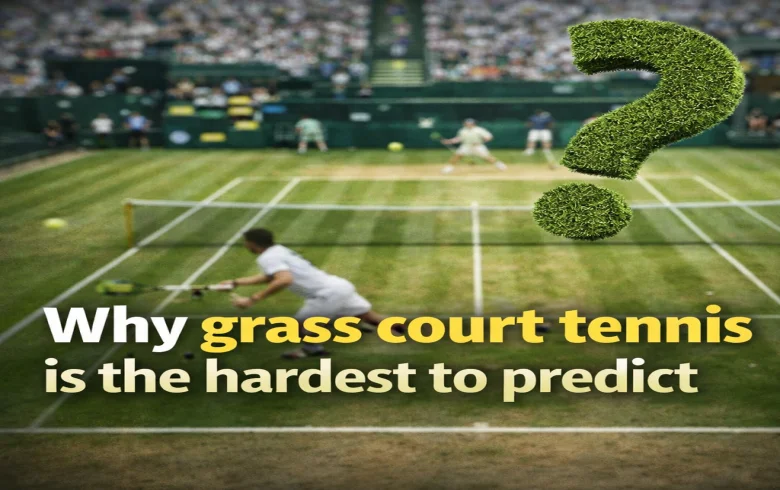
Every sport has a moment that breaks the prediction model. In tennis, that moment comes almost every year at Wimbledon. It arrived with spectacular force in 2025: eight of the top-ten seeds were eliminated in the first round alone — the most ever recorded in the Open era. The French Open champion lost in the first round. The world number three lost in 58 minutes. A player ranked 126th in the world ended a former Wimbledon semi-finalist's campaign before it began.
Was this just a bad year? No. This is grass court tennis — and it has always been like this. Grass is structurally, physically, and mathematically the hardest surface to predict. If you want to get your tennis betting and predictions right during the Wimbledon season, you need to understand exactly why — and what you can do about it.
⚡ The Headline Stat At Wimbledon 2025, 23 seeded men and women were beaten in the first round — the most since the current seeding format began in 2001. Eight of the top ten seeds across both draws were eliminated, a new Open Era record. |
What Makes Grass So Different?
Before getting into the prediction strategy, you need to understand what the surface actually does to the ball and to the players, because it is genuinely unlike any other surface in sport.
The ball skids low and fast
Grass has the lowest coefficient of friction of any tennis surface. When the ball hits the court, it loses very little horizontal speed but loses a lot of vertical height. The result: a ball that skids through fast and stays close to the ground. Players have a fraction of a second less to prepare their shots compared to clay or hard courts. This completely changes timing, footwork, and shot selection.
Topspin loses its power
On clay, topspin is a super-weapon because the ball already bounces high, and topspin amplifies that further. On grass, topspin shots often just skid through — the surface does not give them enough resistance to kick upward. This levels the playing field dramatically: clay court weapons become ordinary grass court shots. Players who rely almost entirely on topspin (think Coco Gauff, Jessica Pegula) are suddenly far less dominant.
The serve becomes the most important shot in the game
Research on Wimbledon match data shows that players who win points directly with their serve — aces and unreturnable serves — win their matches over 70% of the time. On grass, a good serve cannot just be replied to with a strong topspin return because the ball is already low and fast before it reaches the returner. This means a player with a mediocre serve but brilliant groundstrokes is genuinely vulnerable to a player with a huge serve but average groundstrokes.
Movement is treacherous
Grass is the most slippery surface in tennis. Players cannot slide into position the way they do on clay. Shorter, choppier steps are required — a completely different movement pattern that players must drill separately. If you have not trained specifically on grass in the weeks before Wimbledon, your movement will be compromised. This is why the transition from the clay season is so dangerous.
The surface degrades as the tournament progresses
Grass is a living surface — and that means it wears down. In the first round, courts are at their fastest and most uniform. By the second week, worn patches near the baseline create genuinely unpredictable bounces. The same shot that clears the net cleanly in round one might hit a bare patch and skid wide in the quarter-finals. No other tennis surface does this.
Feature | Grass | Hard Court | Clay |
Ball Speed | Very Fast | Medium-Fast | Slow |
Bounce Height | Very Low | Medium | High |
Serve Advantage | Maximum | Medium | Low |
Topspin Effect | Minimal | Medium | Strong |
Surface Changes | Yes — degrades | No | Minimal |
Movement Type | Short/choppy | Normal | Sliding |
Upset Frequency | Very High | Low-Medium | Medium |
Prediction Difficulty | ★★★★★ | ★★★ | ★★★★ |
The Clay-to-Grass Transition: Why It Breaks Everything
The single biggest reason grass court tennis is so hard to predict is the timing. The grass season follows immediately after the clay season, and the two surfaces could not be more different.
Clay: slow, high-bouncing, long rallies, topspin-dominant, sliding movement. Grass: fast, low-bouncing, short points, flat shots, choppy movement. The transition from one to the other happens in roughly two to three weeks. Players who go deep into Roland Garros arrive at Wimbledon physically exhausted and having spent months training patterns that are almost counterproductive on the new surface.
"This Slam, out of all of them, is the most prone to have upsets because of how quick the turnaround is from clay. Most of the seeds are going deeper in Roland Garros, and then you spend a long clay season, and then you have to come and adjust to grass." — Coco Gauff, after her first-round exit at Wimbledon 2025 |
This is not just one player's experience. It is structural. The Wimbledon grass season includes only a handful of warm-up tournaments — Queen's Club and Halle on the men's side, Eastbourne and Bad Homburg on the women's — giving players at most one or two weeks of grass court time before the main event. Compare this to the clay season, which runs for seven to eight weeks and gives players multiple chances to adjust and build form.
The consequence for predictions: clay court form — which is the most recent form available before Wimbledon — is one of the least reliable indicators of grass court performance. A player who has just won Roland Garros may be physically spent and tactically mis-calibrated. A player who finished early in Paris and had two full weeks of grass preparation may be in the best shape of their life.
⚠️ Prediction Trap Do NOT automatically back the French Open champion or semi-finalists at Wimbledon. Recent clay form is often inversely correlated with early Wimbledon performance because fatigue and tactical reset are so demanding. |
The Wimbledon 2025 Upset Breakdown
The 2025 Wimbledon first round was the most dramatic illustration of grass court unpredictability in the Open era. Here is what actually happened — and what each upset tells us about prediction:
Upset | What It Tells Us |
Coco Gauff (No.2 seed) lost in R1 | Won Roland Garros three weeks earlier. Grass record: 27-13, worst of any surface. Topspin game neutralized. |
Jessica Pegula (No.3) lost in R1 in 58 min | Had just won a grass warm-up event. Form meant nothing — surface transition too fast. |
Alexander Zverev (No.3 men's) lost in R1 | Was on a strong grass run leading in. Opponent Rinderknech served at 44/55 net points. Serve domination decides matches. |
Daniil Medvedev (men's) lost in R2 | Earliest exit in 7 Wimbledon appearances. The clay-specialist movement does not transfer. |
Lorenzo Musetti (No.7) lost in R1 | Had no grass warm-up due to injury. Ranked 126, opponent Basilashvili hadn't won a Grand Slam match in 3 years. |
Jack Draper (No.4) lost to 36-yr-old Cilic | Home favourite, major pre-tournament pick. Experience and serve-domination beat ranking. |
The pattern across all six upsets is consistent: players with power-serving, flatter ball-striking games exploited the surface to defeat higher-ranked opponents who had spent the spring on clay. Every single upset was predictable in hindsight using surface-specific logic — and almost none were predicted in advance using standard ranking-based models.
Why Standard Prediction Models Fail on Grass
Most tennis prediction systems — whether simple (look at the ranking) or complex (ELO ratings, head-to-head records) — are built primarily on overall match data, which is dominated by hard court results because hard courts make up the majority of the ATP and WTA calendar.
On grass, this model breaks down for five specific reasons:
- Reason 1. Serve dominance overrides baseline quality. A player ranked 50 in the world with an enormous serve is far more dangerous on grass than their ranking suggests. Ranking does not adequately account for serving speed and accuracy as a stand-alone weapon.
- Reason 2. Grass-specific records are tiny samples. Most players play fewer than 15 grass court matches per year. A single good or bad week massively distorts any grass-specific win percentage. Confidence intervals are huge.
- Reason 3. The surface itself changes. The first-week courts and second-week courts at Wimbledon play measurably differently. A player who thrives early on fresh grass may struggle as patches develop.
- Reason 4. Fatigue is invisible in the rankings. A player is ranked by their historical results, not their current energy levels. Coming off a five-set Roland Garros final four weeks before Wimbledon is not priced into a ranking number.
- Reason 5. Underdogs play with less pressure. At any Grand Slam, underdogs have nothing to lose. On grass, where one big serve can end a point, their weapons are amplified, and the pressure on the favourite to construct points is reduced.
💡 What Works Instead Use grass-specific win percentage where available. Track serve statistics (ace rate, first-serve %, service games held). Consider Wimbledon-specific results separately from overall Grand Slam results. Note preparation schedule — how many grass warm-up matches did each player play? |
The Players Who Always Figure It Out
Despite the chaos, certain players consistently beat the grass court odds. Understanding why tells you the most important thing about predicting Wimbledon correctly.
Carlos Alcaraz — The modern grass master
Alcaraz is the player who, in Coco Gauff's words, 'figured it out.' He won back-to-back Wimbledon titles (2023, 2024) and boasts a 30-3 career grass record — the fastest any No.1-ranked player in the Open era has reached 30 grass wins. His game translates perfectly: explosive but flat groundstrokes, aggressive net approach, a developing serve, and natural movement that adjusts instinctively to the lower bounce.
Novak Djokovic — Seven-time champion
Djokovic is the other player Gauff identified as having it figured out. His game on grass is built on precision: a deceptive serve, a return that neutralizes even huge serves, and movement that stays remarkably stable on a slippery surface. His 7 Wimbledon titles are no accident — he adjusted his entire game model to suit the surface, rather than relying on the clay-court patterns that dominate his training.
Sinner — Adapting fast
Jannik Sinner won his first Wimbledon title in 2025, defeating Alcaraz in the final. His flat, penetrating ball striking suits grass naturally — unlike his clay game, where he must fight against the high bounce. On grass, his forehand and backhand drives at hip height are exactly what the surface delivers. His 2025 Wimbledon victory confirmed that his game has matured to the point where surface transition is less of an issue.
Grass Court Prediction Checklist — 2026 Wimbledon | |
Serve Stats | Check ace rate and first-serve %. Anyone with 6+ aces/match is dangerous, regardless of ranking. |
Grass Record | Look at Wimbledon-specific win %. Ignore overall grass record — sample sizes too small. |
Preparation | How many grass warm-up matches? Players with 2+ grass matches are better calibrated. |
Clay Exit | Did they go deep at Roland Garros? Earlier exit = more rest = potentially better grass form. |
Movement Style | Slide-heavy, heavy-topspin players are structurally disadvantaged. Flat-ball, attack-net players are structurally advantaged. |
Surface Week | First-week courts are faster and more uniform. Later rounds see more unpredictable bounces. |
H2H on Grass | Check head-to-head specifically on grass — even if overall H2H strongly favours one player. |
The 7 Grass Court Prediction Rules
Based on all of the above — the physics, the 2025 upset data, the structural analysis — here are seven concrete rules for predicting grass court tennis:
- Rule 1: Ranking is less reliable on grass than on any other surface. A top-3 seed can lose to a world number 80 in round one without it being a fluke.
- Rule 2: Serve matters more than groundstrokes. When evaluating a match-up, check both players' serving statistics before looking at baseline quality.
- Rule 3: Clay form ≠ grass form. These are opposite surfaces. A player who looked invincible at Roland Garros may look average at Wimbledon if they have not had time to reset.
- Rule 4: Players who are rested and have done grass prep are undervalued. These players will often have longer odds than they deserve.
- Rule 5: The first week is more unpredictable than the second week. Accept a higher margin of error in the first three rounds and be more conservative.
- Rule 6: Alcaraz and Djokovic are the benchmark. Any player at Wimbledon who cannot explain why their serve, net game, and movement are comparable to those of these two is structurally at a disadvantage.
- Rule 7 The upset you didn't see coming is almost always a flat-ball, big-serving player against a topspin-dominant favourite. Look for these matchups specifically.
The Bottom Line: Grass Court Tennis Is a Separate Sport
That might sound like an exaggeration, but the data support it. The surface changes everything: the physics, the shot selection, the movement, the psychological pressure, the serve-return dynamic, and the role of fatigue. A player who is ranked number one in the world, who has been dominant for months, who has won every tournament they have entered, can still walk onto the grass and lose to a qualifier in the first round. And it happens every year.
For tennis predictions, this is both a challenge and an opportunity. The challenge: standard models are less reliable here than on any other surface. The opportunity: if you understand grass court dynamics and apply the rules in this guide, you will find value in matches that the market prices incorrectly, because most prediction systems are not properly calibrated for grass.
The key insight is simple: on grass, the surface is a player. It has preferences; it rewards certain styles and punishes others; it changes during the tournament; and it does not care about rankings, clay-court seasons, or pre-tournament odds. Respect it, and your Wimbledon predictions will be significantly sharper.
Final Verdict
Grass is the hardest surface to predict in tennis because it is fast, low-bouncing, serve-dominant, structurally different from clay (where most pre-Wimbledon form is generated), and it physically degrades during the tournament. Apply grass-specific stats, check preparation schedules, trust flat-ball servers over topspin specialists, and treat the first week with extra caution. The chaos is real — and it is predictable, if you know what to look for.